
By Dr. Frederick Schurger, DC, DCCJP | Keystone Chiropractic | Springfield, IL
If you’re a few weeks or a few months into care at Keystone Chiropractic, you’ve probably had a moment where you stopped to ask yourself: is this actually working?
It’s a fair question — and an important one. Some weeks you feel noticeably better. Other weeks feel about the same as before you started. Maybe you had a stressful week at work, or didn’t sleep well, or sat at a desk for ten hours straight, and the old symptoms crept back in. It’s natural to wonder whether that’s a sign of regression, or just a normal part of the process.
Here’s the honest answer: how you feel on any given day is real, and it matters. But it’s also one of the least reliable ways to measure whether your nervous system is actually healing.
That’s exactly why we don’t rely on it alone.
Why “Feeling Better” Isn’t the Whole Story
Pain and symptoms are influenced by far more than just spinal alignment. Stress, sleep quality, hydration, hormonal changes, activity level, even the weather — all of these affect how you feel from day to day, independent of whether your upper cervical correction is holding or your nervous system is functioning better than it was a month ago.
This creates a real problem if symptoms are the only thing being tracked. A patient having a genuinely good week of healing might still feel rough because they didn’t sleep, and conclude that care isn’t working. A patient who is progressing slowly might feel temporarily great because of a low-stress weekend, and assume everything is resolved when underlying instability is still present.
Neither conclusion is necessarily true. Symptoms are a lagging indicator — they often change well after the underlying function has already started to shift, in either direction. If we only asked “how do you feel today?” at every visit, we’d be making decisions based on noise, not signal.
What We Actually Track
At Keystone Chiropractic, your care plan isn’t built or adjusted based on symptoms alone. We track three layers of information throughout your care, and we revisit all three at your progress exams.
1. Structural Alignment — CBCT Imaging
CBCT cone beam CT imaging shows us, in three dimensions, whether the atlas and axis are holding the correction. This is the most direct evidence of whether the structural component of your care is stable. If imaging shows the correction is holding, that’s meaningful information regardless of how you happen to feel that day.
2. Nervous System Stress — Infrared Thermography
Thermography measures asymmetrical heat patterns along the spine, which reflect nervous system stress and inflammation. As the body adapts to a held correction, thermography patterns typically become more balanced over time. This gives us an objective window into nervous system function that has nothing to do with self-reported symptoms.
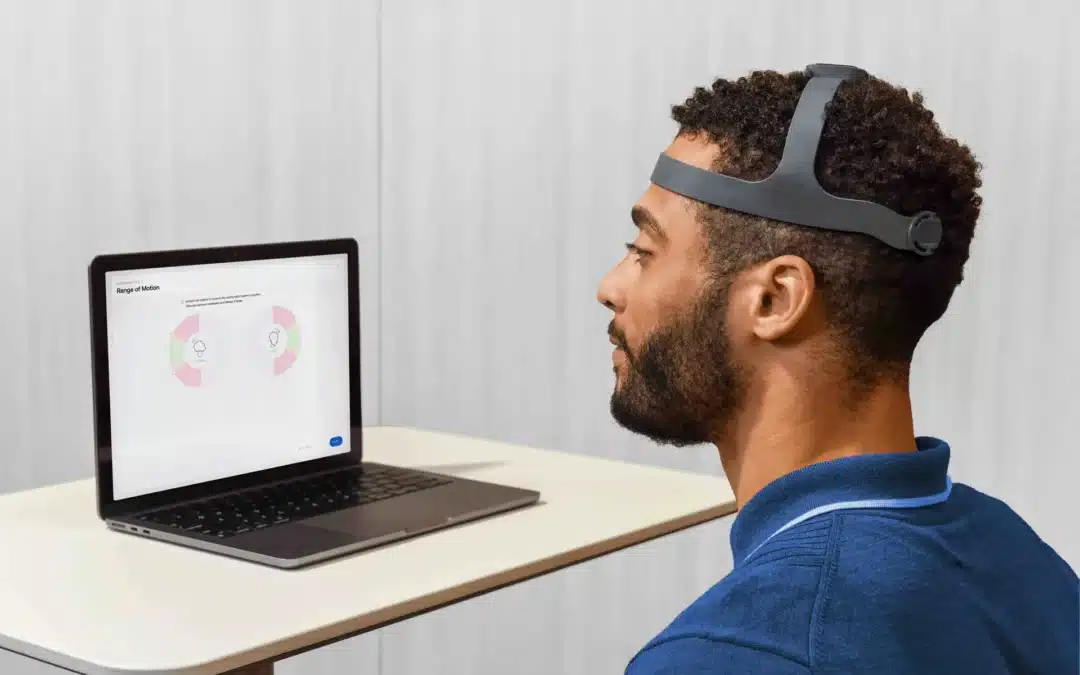
3. Functional Performance — The NeckCare System
This is the piece that most directly answers the question “is my neck actually working better?” The NeckCare System measures three things at your initial evaluation and again at progress exams:
- Cervical range of motion — precise degree measurements across all six directions of neck movement
- Proprioception — how accurately your neck senses its own position in space, measured through the Joint Position Error Test
- Sensorimotor control — how well your neck, eyes, and brain are coordinating, measured through the Butterfly Test®
Each of these produces a number. Not an impression — a number. And that number can be compared directly to the number from your last assessment.
What It Looks Like When the Numbers Move Before the Symptoms Do
One of the most common patterns we see is this: a patient’s NeckCare numbers improve — range of motion expands, proprioceptive accuracy tightens, sensorimotor coordination smooths out — before the patient feels a dramatic difference in their day-to-day symptoms.
This makes sense when you understand how the nervous system heals. Structural correction happens first. Functional adaptation follows. The brain and body need time to recalibrate to the new, corrected position — rebuilding accurate proprioceptive maps, restoring normal movement patterns, and reestablishing healthy sensorimotor coordination. That recalibration process doesn’t always announce itself as “feeling better.” Often it’s quiet, gradual, and easy to miss if you’re only paying attention to symptoms.
When we show a patient their NeckCare comparison report and they can see, in black and white, that their range of motion has expanded by 15 degrees or their proprioceptive error has dropped by half — that’s often the moment they realize something real has changed, even if they hadn’t consciously registered feeling dramatically different yet.
It also works in reverse. Sometimes a patient feels great for a few weeks, and then the numbers show that a particular measure — say, rotation on one side — hasn’t actually improved much. That tells us something specific is still being missed, and it gives us a clear direction for adjusting the care plan before the symptoms come back in full force.
Why This Matters for You, Specifically
If you’re currently in care at Keystone, here’s what this means in practice:
Your progress exams aren’t just a formality. When we re-run your NeckCare assessment, we’re not just checking a box. We’re comparing your current numbers to your baseline and to your most recent prior assessment, and using that comparison to decide whether your current care plan is working as expected or whether something needs to change.
You don’t have to guess whether it’s working. If you’ve ever left a healthcare appointment unsure whether you’re actually getting better, that uncertainty is one of the most common (and most justified) frustrations patients describe. At Keystone, you’ll see your own data. You don’t have to take our word for it.
Plateaus and setbacks get caught early. If your functional numbers stop improving, or move in the wrong direction, that’s information we can act on immediately, rather than waiting for symptoms to clearly signal a problem weeks or months later.
Your care plan stays personalized to where you actually are. Care doesn’t run on a fixed schedule regardless of progress. It’s adjusted based on what the data shows about your specific recovery — which is part of why two patients with similar starting symptoms can end up on very different care timelines.
A Note on Patience and Process
Healing isn’t linear, and it’s rarely as fast as anyone would like. If you’ve had a difficult week and you’re wondering whether you’re losing ground, that’s a completely reasonable thing to bring up at your next visit — and we’d genuinely rather you ask than quietly worry about it.
But also know this: the absence of dramatic symptom relief in any given week is not the same as the absence of progress. Your nervous system, your spine, and your body are adapting on a timeline that doesn’t always match how you happen to feel on a Tuesday afternoon. That’s precisely why we built objective tracking into every stage of care here — so neither of us has to rely on guesswork to know whether what we’re doing is working.
Questions About Your Progress?
If you’re currently in care and have questions about your own NeckCare results, your imaging, or what your progress exam showed, don’t wait for your next scheduled visit to ask. Call the office and we’re glad to walk through it with you.
And if you’re not yet a patient but have been dealing with symptoms you’d like real answers about — not just temporary relief — learn more about how the NeckCare assessment works, or go ahead and schedule your first evaluation.
Schedule Your Evaluation at Keystone Chiropractic →
Or call us directly: (217) 698-7900
Keystone Chiropractic | 450 S Durkin Drive, Ste B, Springfield, IL 62704 | (217) 698-7900
Dr. Frederick Schurger, DC, DCCJP — Blair Upper Cervical Chiropractor serving Springfield and Central Illinois since 2007.
Related Reading:
- The NeckCare System at Keystone Chiropractic
- Blair Upper Cervical Chiropractic — How It Works
- About Dr. Frederick Schurger, DC, DCCJP
- New Patients — Schedule Your First Visit