
Most people who walk into a chiropractor’s office leave with two things: an adjustment and a feeling. Maybe the feeling is good. Maybe it’s the same. Either way, it’s subjective — there’s no number attached to it, no visual, no before-and-after comparison that tells you whether your neck is actually functioning better.
At Keystone Chiropractic in Springfield, IL, Dr. Schurger uses the NeckCare System™ to change that.
NeckCare is an FDA-listed assessment device built on over 20 years of research. It gives us objective, quantifiable data on how your cervical spine is actually functioning — not just how it looks on an X-ray, and not just how you feel on a given day. That data shapes your care plan from the very first visit, and it gives us something to measure against as your treatment progresses.
If you’ve been told your imaging looks normal but you still don’t feel right — or if you’ve been through care before and aren’t sure whether things are actually improving — this is the kind of precision that makes a difference.
Schedule your upper cervical evaluation with NeckCare assessment →
Why Objective Testing Matters in Upper Cervical Care
Upper cervical chiropractic is already more precise than general chiropractic. The Blair Upper Cervical Technique that Dr. Schurger uses relies on advanced imaging — including CBCT cone beam CT scanning and infrared thermography — to identify misalignments at the atlas and axis with a level of accuracy that standard X-rays can’t provide.
NeckCare adds a third dimension to that precision.
Where imaging tells us about the structure of your spine, and thermography tells us about nervous system stress, NeckCare tells us about function — how your neck is actually moving, how accurately it senses its own position in space, and how well your brain and neck are coordinating with each other.
These are different things. A spine can look relatively normal on imaging and still be functioning poorly. The muscles and nervous system can be compensating in ways that imaging doesn’t capture. NeckCare measures those compensations directly — and puts numbers to them.
For patients dealing with vertigo, chronic headaches, post-concussion symptoms, whiplash, or neck pain that hasn’t responded to previous care, this level of functional assessment often reveals things that were missed — and gives us a clear, evidence-based starting point for care.
What the NeckCare System Measures
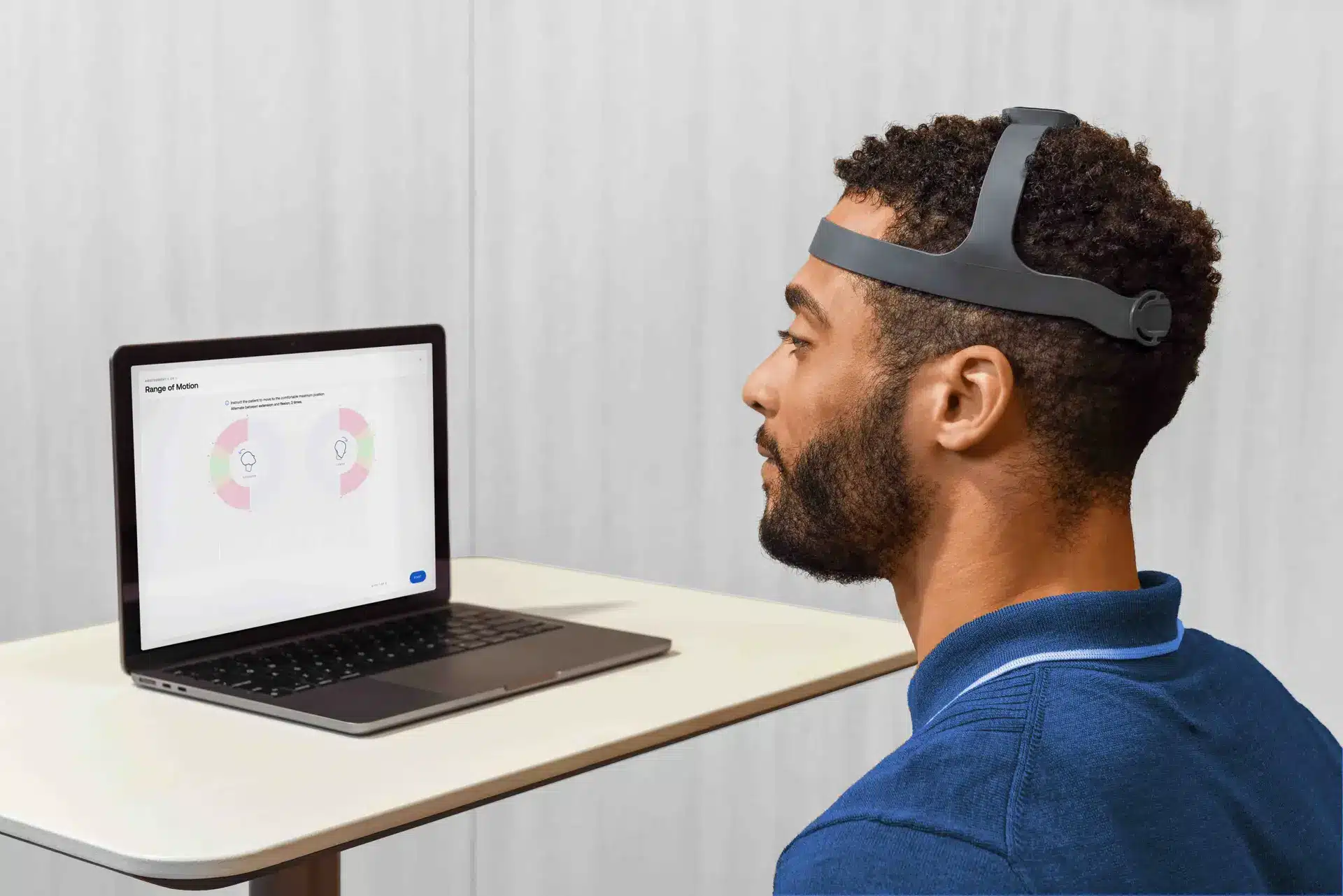
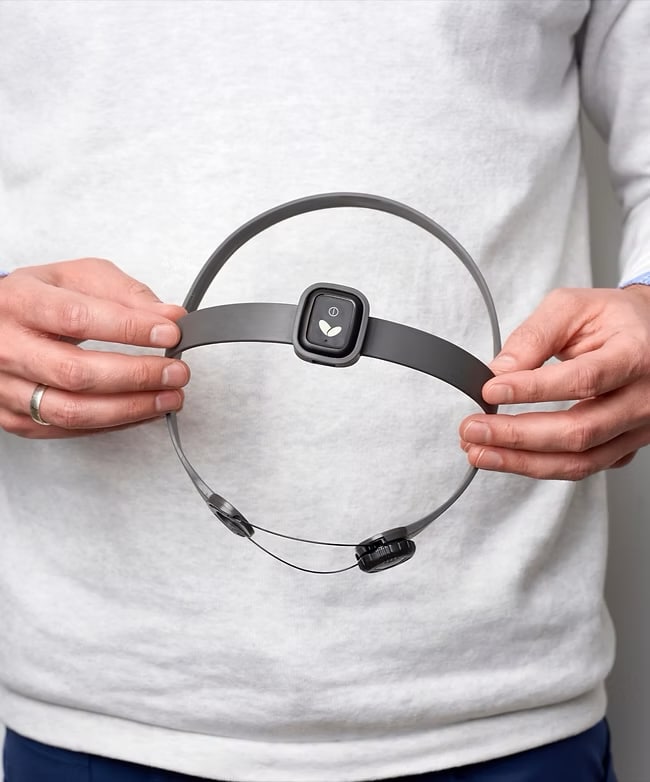
The NeckCare assessment uses a lightweight wearable sensor worn on top of the head. It captures over 120 positional data points per second and runs three specific tests. Together, they give us a complete picture of how your cervical spine is functioning right now.
1. Cervical Range of Motion
The first test measures how far your neck moves in all six directions: flexion (chin to chest), extension (looking up), left and right rotation, and left and right lateral flexion (ear to shoulder).
This sounds simple — but the precision of the NeckCare device goes well beyond what a clinician can observe or estimate manually. It captures the full arc of movement in degrees, identifies restrictions at specific points in the range, and flags asymmetries between sides that might not be obvious during a visual assessment.
The entire test takes under two minutes. When we re-run it at your progress exams, we’re comparing exact numbers — not impressions.
What this tells us: Where movement is restricted, which directions are most affected, and whether the pattern matches what we’d expect given your symptoms and imaging findings.
2. Joint Position Error Test — Proprioception
Proprioception is your body’s ability to sense where it is in space — without looking. In the neck, this is particularly important because the upper cervical region is packed with sensory receptors that constantly report head position to the brainstem.
When the atlas or axis is misaligned — or when there’s been trauma to the neck — those receptors can be disrupted. The brain stops receiving accurate position information. This is one of the mechanisms behind cervicogenic vertigo, dizziness, chronic neck instability, and balance problems.
The Joint Position Error test measures this directly. You close your eyes, move your head to a target position, and then try to return accurately to neutral. NeckCare measures how far off you land — in degrees — compared to where you started. That “error” is your proprioceptive accuracy score, and it’s compared against normative data from healthy individuals.
What this tells us: Whether your neck’s sensory system is working accurately, and whether that inaccuracy is likely contributing to symptoms like dizziness, instability, or persistent pain.
This test is especially valuable for patients with vertigo, post-concussion symptoms, whiplash injuries, and Meniere’s disease — conditions where the connection between neck function and neurological symptoms is most direct.
3. The Butterfly Test® — Sensorimotor Control
The Butterfly Test® is NeckCare’s most unique assessment. It evaluates sensorimotor control — the coordination between what your brain intends and what your neck and eyes actually do together.
During the test, you wear the head sensor and follow a moving visual target on a screen by moving your head in sync with it. NeckCare tracks your head movements and compares them to the target’s path, measuring accuracy, smoothness, timing, and response.
This tests the integration between your visual system, your vestibular system, and your cervical spine — the same three-way conversation that governs your sense of balance. When that integration is disrupted by neck dysfunction or injury, it shows up here in ways that no other single test captures.
What this tells us: How well your neck, eyes, and brain are coordinating — and whether deficits in that coordination are contributing to dizziness, balance problems, headaches, or the kind of “foggy” instability that many patients with upper cervical dysfunction describe but struggle to explain.

How the Assessment Works — What to Expect
The NeckCare assessment is comfortable, non-invasive, and takes under ten minutes from start to finish.
You sit upright in a chair. The lightweight sensor is placed on top of your head. Dr. Schurger walks you through each of the three tests one at a time, with simple instructions for each. There’s no pain involved, no awkward positioning, and nothing physically demanding.
By the end, we have a baseline — an objective picture of how your cervical spine is functioning right now. That baseline does several important things:
- It makes your care plan specific to you. If range of motion is restricted in rotation but proprioception is the more significant issue, the approach reflects that from day one — rather than starting with a generic protocol.
- It gives you something to look at. The NeckCare system generates visual reports that show your results compared to normative data. Most patients find this genuinely eye-opening — not because the findings are dramatic, but because seeing your own data makes the problem real and tangible in a way that a verbal explanation rarely does.
- It creates accountability. When we re-run the assessment at your progress exams, we’re not asking “how do you feel?” We’re comparing numbers. That’s a different kind of conversation — and a more honest one.
How NeckCare Fits Into Your Care at Keystone
The NeckCare System isn’t a standalone treatment — it’s a diagnostic and tracking tool that works alongside the rest of what makes Keystone Chiropractic different.
Here’s how it fits into a typical patient journey:
At Your First Visit
Your initial evaluation at Keystone already includes a detailed health history, infrared thermography, postural assessment, and precision imaging when appropriate. The NeckCare assessment adds a functional baseline — a measurement of how your neck is moving, sensing, and coordinating that complements everything else Dr. Schurger uses to understand what’s happening in your upper cervical spine.
Together, these tools give Dr. Schurger a more complete picture than any single test alone. Learn more about Dr. Schurger’s approach and credentials.
As Your Care Progresses
Progress exams at Keystone include re-testing with NeckCare. This means you can see — in actual numbers — whether your range of motion has expanded, whether your proprioceptive accuracy has improved, and whether your sensorimotor coordination is trending in the right direction.
For many patients, these numbers change before their subjective symptoms fully resolve. That’s valuable information: it tells us that the correction is working and the nervous system is adapting, even if the experience of improvement is still emerging.
For Specific Conditions
NeckCare is particularly valuable for patients whose symptoms involve a neurological or sensorimotor component:
- Vertigo and dizziness — The proprioception and Butterfly tests directly assess the neck’s contribution to balance dysfunction.
- Post-concussion syndrome — Sensorimotor testing adds clinical insight and helps guide the pace and focus of care.
- Whiplash injuries — Objective range of motion and proprioception data supports recovery planning and documentation.
- Chronic headaches and migraines — Cervical dysfunction is a common and often overlooked contributor; NeckCare helps identify whether functional deficits are present.
- Neck pain — Range of motion testing establishes exactly where restriction exists and tracks recovery over time.
- Meniere’s disease — Proprioceptive and sensorimotor findings help clarify the upper cervical contribution to inner ear symptoms.


What Patients Learn From Their Results
One of the most consistent things patients say after their NeckCare assessment is that it made their condition feel real in a way it hadn’t before.
Many people who come to Keystone have been dealing with their symptoms for months or years. They’ve had imaging that came back normal. They’ve been told there’s nothing structurally wrong. They’ve started to wonder whether the problem is in their head.
When NeckCare shows a measurable deficit in proprioceptive accuracy, or a clear restriction in range of motion on one side, or a sensorimotor coordination pattern that falls outside normal range — that data is validating. It puts a number to something that previously had no number. It gives Dr. Schurger specific findings to address, and it gives patients a reason to trust that the care is targeted at something real.
And when those numbers improve over time — which they often do — patients can see their own progress instead of just hoping it’s happening.
Frequently Asked Questions About the NeckCare System
What is the NeckCare System?
The NeckCare System™ is an FDA-listed wearable assessment device that objectively measures cervical spine function. It captures over 120 positional data points per second and evaluates range of motion, proprioception, and sensorimotor control using three specific tests. It has been developed through over 20 years of research and is used by chiropractors, physical therapists, and concussion specialists across North America.
Is the NeckCare assessment painful or uncomfortable?
No. The assessment is entirely non-invasive and comfortable. You sit upright, wear a lightweight head sensor, and follow simple instructions for each of the three tests. There’s no pressure applied to the neck, no awkward positioning, and nothing physically demanding. Most patients complete the full assessment in under ten minutes.
How is NeckCare different from a standard chiropractic exam?
A standard chiropractic exam typically involves manual range of motion testing (estimated visually), orthopedic tests, and patient-reported symptoms. NeckCare replaces estimated observations with precise, quantifiable measurements captured at over 120 data points per second. It also assesses proprioception and sensorimotor control — two functions that standard exams don’t measure at all.
Who benefits most from NeckCare assessment?
NeckCare is valuable for virtually any patient with cervical spine involvement, but it’s especially useful for people dealing with vertigo, dizziness, post-concussion symptoms, whiplash, chronic headaches, Meniere’s disease, and neck pain that hasn’t responded to previous care. It’s also useful for patients whose imaging looks relatively normal but who still have significant symptoms — the functional assessment often reveals what the structural imaging doesn’t.
How often is the NeckCare assessment repeated?
The assessment is run at your initial evaluation to establish a baseline, and then again at progress exams to measure change over time. The frequency of progress exams depends on your individual care plan and how quickly your spine is stabilizing.
Does NeckCare replace imaging or thermography?
No — it complements them. CBCT imaging tells us about the structure of your spine. Infrared thermography tells us about nervous system stress patterns. NeckCare tells us about function — how your neck is actually moving and coordinating. Together, these tools give Dr. Schurger a more complete picture of what’s happening than any single test alone.
Do you use NeckCare for every patient?
Dr. Schurger incorporates NeckCare as part of the evaluation process for new patients and at progress checkpoints. It is particularly emphasized for patients whose symptoms suggest cervical sensorimotor involvement — vertigo, dizziness, post-concussion presentations, and complex cases where functional assessment adds clinical value beyond imaging alone.
Is Keystone Chiropractic the only practice in Springfield using NeckCare?
The NeckCare System is used by a relatively small number of chiropractic practices in the U.S. Dr. Schurger’s use of it — combined with CBCT imaging, infrared thermography, and the Blair Upper Cervical Technique — reflects his commitment to using the most precise and evidence-informed tools available in his specialty.
Ready to Find Out How Your Neck Is Actually Functioning?
If you’ve been dealing with neck pain, vertigo, headaches, or any condition that hasn’t responded the way you expected — or if you’ve been through care before and aren’t sure whether things are actually improving — a NeckCare evaluation gives you answers that are grounded in data, not guesswork.
Dr. Schurger serves patients from Springfield, Chatham, Rochester, Sherman, Riverton, Athens, Jacksonville, Lincoln, and across Central Illinois. You don’t need a referral. You don’t need a prior diagnosis. If you’re ready to find out what’s really going on, we’d love the opportunity to show you.
Schedule your upper cervical evaluation with NeckCare assessment →
Or call us directly: (217) 698-7900
Keystone Chiropractic | 450 S Durkin Drive, Ste B, Springfield, IL 62704 | (217) 698-7900
Dr. Frederick Schurger, DC, DCCJP — Blair Upper Cervical Chiropractor serving Springfield and Central Illinois since 2007.
Related Reading:
- Blair Upper Cervical Chiropractic — How It Works
- Vertigo Relief in Springfield, IL
- Post-Concussion Care at Keystone Chiropractic
- Whiplash and Auto Accident Injury Treatment
- Headaches and Migraines
- New Patients — Schedule Your First Visit