
Many of the patients who find their way to us have a complicated relationship with chiropractic. Some have never been to a chiropractor because they are uneasy about having their neck twisted. Others have been adjusted many times, felt better for a day or two, and ended up right back where they started. Almost all of them have the same first question about the Blair technique: what actually happens?
This article answers that question in plain language: what the Blair upper cervical technique is, why it focuses on such a small area, how it differs from the chiropractic most people picture, and what a visit feels like from the patient’s side of the table.
What Is the Blair Technique?
The Blair technique is a form of upper cervical chiropractic, meaning it focuses specifically on the top two bones of the spine: the atlas (C1) and the axis (C2). It was developed in the 1950s by Dr. William Blair, and it is built on one central idea: the joints at the top of every person’s neck are shaped differently, so the correction should be designed around that individual anatomy rather than a standard textbook model.
In practical terms, Blair care means a detailed analysis of how your upper neck is shaped and positioned, followed by a gentle, precise correction made by hand along the specific angle of your joints. No twisting. No cracking.
Why Focus on the Top of the Neck?
The atlas and axis are small bones with a large job. Together they support the weight of your head, roughly 10 to 12 pounds, and allow most of the rotation in your neck. They also surround the junction where the brainstem transitions into the spinal cord, the pathway that carries information between your brain and the rest of your body.
Unlike the rest of the spine, the atlas has no interlocking bony structure holding it in place. It relies on ligaments and small muscles. That makes the region remarkably mobile, and also vulnerable to injury from car accidents, falls, sports impacts, and other trauma.
The upper neck is also densely packed with sensors that continuously report your head’s position to your brain. When the region is misaligned or moving abnormally, the effects can extend well beyond neck pain, influencing headaches, balance, and how the nervous system processes information. You can read more on our Blair upper cervical page.
The Core Idea: Your Joints Are Not Shaped Like Anyone Else’s
Most people picture the spine as a neat stack of identical blocks. The upper neck does not work that way. The joint surfaces where the skull meets the atlas vary in angle, depth, and shape from person to person, and often differ between the left and right side of the same person.
This matters because a correction delivered in the wrong direction does not correct much. A general adjustment assumes a standard joint angle. A Blair correction is planned around the angle your joints actually have. That is why imaging is central to the technique: before anything is adjusted, the doctor needs to see the exact geometry of your upper neck.
Blair analysis was originally built on a series of specialized X-ray views designed to show these joint angles. At Keystone Chiropractic, we use CBCT cone beam CT scanning, which shows the upper cervical joints in three dimensions.
How a Blair Correction Is Different
- No twisting or cracking. The neck is not rotated to produce a joint release, and there is typically no popping sound.
- Specific direction. The correction follows the measured angle of your own joints, not a generic line of force.
- Low force. The input is light and quick, delivered by hand. Precision, not force, is what makes it effective.
- Only when needed. The goal is for a correction to hold, so you are adjusted only when exam findings show it is necessary.
If previous chiropractic care has left you frustrated, Frustrated With Chiropractic Care? Why Some Patients Need a Different Approach explains why a more specific method can make a difference.
What a Blair Visit Looks Like
1. A Check Before Anything Is Adjusted
Each visit begins with an assessment of whether your upper neck is holding its correction. This can include a postural and leg length check and a thermography scan, which shows patterns of nervous system stress. If your findings show you are holding well, you are not adjusted that day.
2. The Correction
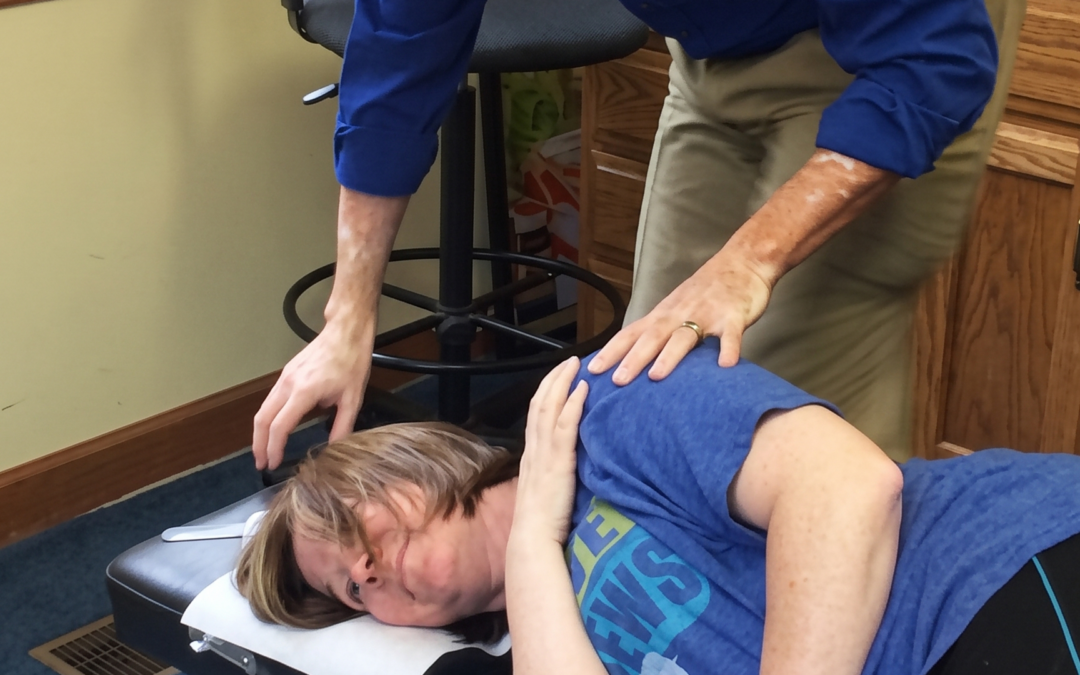
When a correction is needed, you lie on your side with your head supported on a specialized headpiece. Dr. Schurger positions his contact based on your imaging and delivers a single light, quick input along your specific joint angle. It takes a moment. Most patients feel very little, and some notice brief pressure at the base of the skull.
3. Rest
After each adjustment, you rest in a zero gravity chair for approximately 30 minutes. This allows the surrounding muscles and ligaments to settle into the corrected position before you return to normal activity.
4. A Recheck
Your findings are checked again to confirm the correction is in place. Over time, the goal is for corrections to hold longer, which means fewer adjustments and less frequent visits.
What Happens at Your First Visit
Before any care begins, your first visit focuses on a thorough history and evaluation. We use three diagnostic tools together, because each one shows something the others cannot:
- CBCT cone beam CT scanning: 3D imaging of the upper cervical spine and craniocervical junction, showing the precise position and structure of the atlas and axis. Keystone Chiropractic is one of very few chiropractic practices in Central Illinois using CBCT.
- Infrared thermography: a noninvasive scan that identifies nervous system stress patterns along the spine.
- The NeckCare System: an FDA-listed functional assessment backed by over 20 years of peer-reviewed cervical spine research, capturing more than 120 positional data points per second. It includes three tests: Cervical Range of Motion, which measures precise degrees of movement in all six directions; the Joint Position Error Test, which measures how accurately you return your head to neutral with your eyes closed; and the Butterfly Test, which measures sensorimotor coordination between your neck, eyes, and nervous system.
CBCT shows the structure. Thermography shows how the nervous system is responding. The NeckCare System shows how your neck is functioning. Together they determine whether Blair care is appropriate for you and give us a measurable baseline. Learn more on our NeckCare System page, and see How We Track Your Progress for how retesting works over time.
Who Seeks Out Blair Care?
Patients come to us for a range of concerns, and many have already tried several other approaches. Common reasons include:
- Chronic neck pain
- Headaches and migraines
- Vertigo and Meniere’s disease
- Post-concussion symptoms and whiplash
- TMJ dysfunction and trigeminal neuralgia
- Fibromyalgia
To be clear about what Blair care is and is not: it does not cure any of these conditions. It addresses a specific structural problem at the top of the neck. When that problem is contributing to someone’s symptoms, correcting it allows the nervous system to function normally again, and many patients improve as a result. When it is not a significant factor, the evaluation should say so.
What to Look For in a Blair Chiropractor
Because the technique depends on precise analysis, training and experience matter. Ask whether the practice uses imaging specific to the upper neck, whether care is based on measurable findings rather than a fixed schedule, and whether progress is tracked objectively. Our article on red flags in chiropractic care covers other warning signs worth knowing.
About Dr. Frederick Schurger
Dr. Frederick Schurger, DC, DCCJP, has practiced Blair upper cervical care in Springfield since 2007. Before chiropractic, he earned a BS in Mechanical Engineering from Rose-Hulman Institute of Technology, a background well suited to a technique built on joint angles and precise lines of force. He earned his Doctor of Chiropractic from Palmer College of Chiropractic in 2006.
His Blair-specific training goes well beyond basic certification. He earned Blair Proficiency and Teaching Certification in 2010 and became a Blair Advanced Instructor in 2013, and he has presented multiple times at the national Blair Chiropractic conference. In 2011 he was named Blair Chiropractor of the Year, an award selected annually by the President and senior board members of the Blair Chiropractic Members Association, open to any member of the society, and recognizing outstanding contributions to promoting and advancing the Blair technique.
He also holds the Diplomate in Chiropractic Craniocervical Junction Procedures (DCCJP), a three-year post-doctoral program involving approximately 300 hours of advanced coursework, original research, and a three-day board examination covering upper cervical anatomy, neuroscience, comparative upper cervical techniques, and craniocervical junction procedures. It is held by very few practitioners nationwide. He has taught neurology and upper cervical anatomy at Logan University College of Chiropractic and to practitioners in the Gonstead organization. Read his full background on our About page.
Frequently Asked Questions
Does a Blair adjustment hurt?
Most patients feel very little. The correction is a light, quick input by hand, and many people are surprised by how gentle it is. Some notice brief pressure at the base of the skull. There is no twisting of the neck.
Will I hear a crack or pop?
Usually not. Blair corrections do not rely on twisting or rotating the neck to create a joint release, so the popping sound people associate with chiropractic is not part of the technique.
How often will I be adjusted?
The goal of Blair care is for each correction to hold. Your upper neck is checked at each visit, and you are adjusted only when the exam findings indicate it is needed. As corrections hold longer, visits typically become less frequent.
How is Blair different from other upper cervical techniques?
Other upper cervical techniques, such as NUCCA and Atlas Orthogonal, also focus on the top of the neck. Blair is distinguished by its emphasis on analyzing the unique shape and angle of each patient’s upper cervical joints and delivering the correction by hand along that specific angle.
Is Blair care appropriate for children and older adults?
Because the technique is gentle and low-force, it is used with patients across a wide range of ages. Every patient is evaluated first to make sure care is appropriate for their age, health history, and findings. Our kids chiropractic page covers care for younger patients.
Find Out Whether Blair Care Is Right for You
If you have been curious about upper cervical care but unsure what to expect, the best first step is an evaluation. Keystone Chiropractic is located at 450 S Durkin Drive, Ste B, in Springfield, IL, and sees patients from Chatham, Rochester, Sherman, Riverton, Taylorville, Jacksonville, Lincoln, and across Central Illinois. We are open Monday, Wednesday, and Thursday from 9:00am to 6:00pm.
Call (217) 698-7900 or visit our New Patients page to schedule your consultation.